Affichage des articles dont le libellé est Tablets. Afficher tous les articles

jeudi 17 novembre 2011

Instant mobile networking: Smartphones get smarter


November 11, 2011

Mobile devices packed with NFC, Wi-Fi Direct, and Bluetooth hint at what's coming in ad hoc communications


There's been a lot of excitement in some quarters around Google's decision to enable near-field communications (NFC) data-sharing in Android 4 "Ice Cream Sandwich." The news builds on Research in Motion's inclusion of NFC in its latest crop of BlackBerrys and Microsoft's announcement that it would add NFC APIs to its Windows Phone 7 smartphone OS in 2012.
You can add to that hubbub Apple's recent adoption of the Bluetooth 4 spec (aka Bluetooth Smart) in its iPhone 4S and the finalization a year ago of the Wi-Fi Direct standard. These three technologies allow direct connections among devices, eliminating the need for a router or other network for communication.
[ Discover the truth about 4G cellular neworks. | Learn how to manage iPads, iPhones, Androids, BlackBerrys, and other mobile devices in InfoWorld's 20-page Mobile Management Deep Dive PDF special report. | Keep up on key mobile developments and insights via Twitter and with the Mobile Edge blog and Mobilize newsletter. ]
Most of the early NFC buzz was around mobile payments, where a smartphone could communicate payment information to a point-of-sales (POS) terminal. But that technology is old news -- contactless payment cards have been around for years, though not widely used.
Plus, you don't really need two-way communication for such payments. Contactless payment technologies such as RFID serve the same purpose by presenting the user identity to the payment terminal, which then connects to the payment system over the network -- is exactly how debit cards and credit cards already work. RFID has been proposed for such usage for a decade, but that hasn't happened much either. Honestly, swiping a debit card is not a big deal, so the rationale for retooling the entire payment system is suspect.
But if you look beyond POS payments, something more interesting -- and useful -- is going on. That's the idea of ad hoc networks, where people can exchange information among one another and/or a collection of their own devices without an active Internet connection. Think iCloud without a network.
We've seen a variety of starts in such short-range connections. Remember the "bump to sync" apps for iOS that used the motion sensor to detect brief physical contact between two iPhones to allow business-card exchange? Or the touch-to-sync feature in some Palm smartphones and the Hewlett-Packard TouchPad that used a tangible touch to trigger sensors and initiate a transfer of information such as current URL or current email message from one device to another? NFC, Wi-Fi Direct, and Bluetooth get rid of the tactile kickoff.
Speaking of Bluetooth, why do we need anything else for ad hoc networking? Isn't that the whole point of the technology? It is, but several problems have restrainted Bluetooth's use. One limit is its dependence on profiles that all devices need to know about in order to connect. That becomes a nightmare for device makers to manage, and efforts by groups such as the Open Mobile Terminal Platform only partially address the issue.
Another limit is its need for explicit pairing, which usually takes several steps that users are unlikely to take for casual sharing, such as in an elevator or lobby. It's one thing to make the effort to pair your Bluetooth headset to your smartphone, as you'll use that pair repeatedly in the future, but quite another to do so in a meeting room with someone you just met and may never see again.
A third limit is that Bluetooth saps power fast. The new Bluetooth 4 spec addresses that, but chips are only now coming to the market, and the iPhone 4S is so far the only nonsensor device to use it. The new Bluetooth spec also speeds the data throughput, a limitation in previous versions that made it unsuitable for large file shares, screen sharing, or video streaming.
12
http://www.infoworld.com/d/mobile-technology/instant-mobile-networking-smartphones-get-smarter-178661?source=IFWNLE_nlt_networking_2011-11-15

jeudi 22 septembre 2011

Gartner: Apple iPad Will Be Top Tablet Through 2014

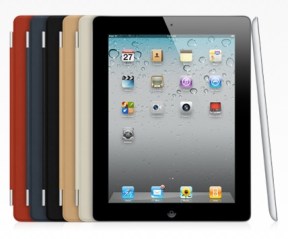
iPad 2

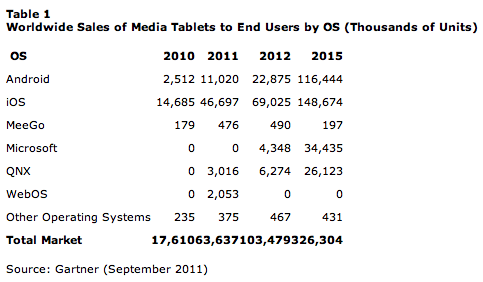
The analysts at Gartner have released a new report today, detailing tablet market trends and forecasts. Not surprisingly, their findings confirm the obvious: the iPad is killing it. According to the firm, the Apple iPad will account for 73.4% of tablet sales worldwide this year, and no other platform besides Android will have more than a 5% share of the market during this time.

In addition, Apple will continue to have more than 50% of the tablet market until 2014, according to research VP Carolina Milanesi, a stat that she attributes to Apple’s foresight to create this market in the first place, and Apple’s “superior and unified user experience across its hardware, software and services.”

Milanesi suggests that competitors who don’t deliver a similar experience won’t be much of a challenge to Apple going forward. That said, competitors’ offerings did affect Apple’s tablet sales ever-so-slightly. Apple is projected to have, as noted above, 73.4% of the market in 2011, but that’s down from 83% in 2010.

Meanwhile, Android tablets will account for 17.3% of the market this year, with 11 million units shipped. Last year, Android accounted for 14.3% of the market share.

But Gartner is lowering Android’s forecast from last quarter’s projection, Milanesi said, because the platform has been “constrained by high prices, weak user interface and limited tablet applications.” The reduction would have been even greater, Gartner claims, if not for the success of low-end tablets in Asia and the expectation around Amazon’s Android tablet. (Which, frankly, the firm may be underestimating a bit.)

Not everything seemed entirely on point with the report. For example, Gartner called RIM’s QNX OS a “promising platform” but said the company is “going through a tough period.” That’s more than kind, given RIM’s troubles and plummeting market share. Calling RIM’s current situation “a tough period” seems to imply that the smartphone maker will reach the other side at some point, wipe its brow, and exclaim, “Whew! We made it!” Whether that will actually happen is decidedly unclear.

Gartner is less kind to Windows 8, whose future may be limited by its late arrival. The platform’s best opportunities may be in the enterprise, Gartner says.

As for anyone daring to take on iPad, the focus should be matching screen quality and processing power on the hardware side, with everything else considered “nice to have, rather than essential.” On the platform side, apps, an intuitive user interface and the ability to share content between devices matter most. Good luck, non-iPads. That’s a tough order to fill.

http://techcrunch.com/2011/09/22/gartner-apple-ipad-will-be-top-tablet-through-2014/?utm_source=feedburner&utm_medium=email&utm_campaign=Feed%3A+Techcrunch+%28TechCrunch%29

mercredi 14 septembre 2011

Why IT will hate Windows 8

September 13, 2011

A new UI, demand for new hardware, and multidevice sharing will freak out companies seeking to save money, maintain control

Why IT will hate Windows 8

All those IT people who wish the iPad would die already, you ain't seen nothing yet. Microsoft is promising that Windows 8 and its Metro-based UI will run on any PC that runs Windows 7, but that's a meaningless promise. To take real advantage of Windows 8 you need new hardware, either touchscreen PCs or touchscreen laptops. Users will very likely want Windows 8 tablets, especially if you've been denying them iPads due to security and management reasons.

In these tough times, most companies aren't willing -- or able -- to pay for new equipment. As a result, users will end up running old hardware and software, and they'll feel they're more and more hobbled by IT. They may bring in fewer rogue iPads, but only because they'll bring in rogue Windows 8 tablets instead.

Likewise, if Apple's iCloud freaks you out, wait till users start syncing their home and work PCs and tablets via Microsoft's Windows Live service and its online Skydrive storage. Microsoft says Live's credentials are solid, but even if that reduces unauthorized access, that still means users' data will easily flow in and out of your company. You could deploy very strong Windows management capabilities as a buffer -- but that translates to further investment on the server side.

When the iPad gave users a weapon to pierce through the corporate technology wall, IT grumbled but could take solace in the fact that Apple's corporate presence was trivial at best. Not so with Windows -- it's the "consumerization of IT" threat gone nuclear.

Of course, that's the fear-based reaction. Apple may have given it voice, but the transition to user-driven computing is neither new nor bad. It just is. Smart IT can adapt to this reality constructively, using policy-based approaches. The rest will shake their fists harder, one toward Cupertino and the other toward Redmond.

This article, "Why IT will hate Windows 8," was originally published at InfoWorld.com. Get the first word on what the important tech news really means with the InfoWorld Tech Watch blog. For the latest business technology news, follow InfoWorld.com on Twitter.


http://www.infoworld.com/t/microsoft-windows/why-it-will-hate-windows-8-172936?source=IFWNLE_nlt_daily_2011-09-13

mercredi 27 juillet 2011

Galaxy Tab LCD beats iPad 2 in viewing comparisons (spoiler: just barely)

By Jason D. O'Grady | July 26, 2011, 8:00am PDT

Summary

DisplayMate performed in-depth lab and viewing tests of the iPad 2, Motorola Xoom, Asus Transformer, Acer Iconia, and Samsung Galaxy Tab 10.1 — and the results may surprise you.

Blogger Info

Jason D. O'Grady
David Morgenstern

The LCD display panel in a tablet computer is the single most expensive and important hardware component because it determines the quality of the visual experience for every application it runs. DisplayMate Technologies Corporation’s Ray Soneira performed in-depth lab and viewing test comparisons of the iPad 2, Motorola Xoom, Asus Transformer, Acer Iconia, and Samsung Galaxy Tab 10.1 — and the results may surprise you.

And the winner is…

While the iPad 2 display easily outperformed all of the previous Android Tablets, with the new Galaxy Tab 10.1, Samsung has delivered the first Android Tablet with an impressive, potentially outstanding display, but then ruined it by turning up the color level to obnoxious levels – apparently in an effort to overcompensate and blatantly standout from the other mobile LCD displays that have subdued color. But in the case of color, too little is a lot better than too much…

As a result the iPad 2 still delivers the best color picture quality and accuracy of all of the Tablets, even though its colors are somewhat subdued. As things stand, based on all of the display tests, the iPad 2 and Galaxy Tab 10.1 are reasonably close in performance in most categories, so it’s almost a tie, but the Galaxy Tab is ahead more often than the iPad 2, so the Galaxy Tab is the Winner, by a nose…

Although the results skew ever so slightly toward the Galaxy Tab, it’s unlikely that any of the current crop of tablets would be able to beat an iPad 3 packing a Retina Display (as has been rumored) but we’ll have to reserve judgement until the new iPad ships — possible as soon as this Fall.

Read the rest of the tablet LCD shootout for the full results and conclusions.

http://www.zdnet.com/blog/apple/galaxy-tab-lcd-beats-ipad-2-in-viewing-comparisons-spoiler-just-barely/10696?alertspromo=&tag=nl.rSINGLE

BGR posts image gallery of rumored HTC 10 inch Android tablet

By Matthew Miller | July 26, 2011, 8:20am PDT

Summary

HTC is likely working on a 10 inch Android tablet and BGR now has an image gallery of this rumored device.

Blogger Info

Matthew Miller
Joel Evans

BGR just posted an image gallery of a 10 inch HTC Android tablet, currently named the HTC Puccini. I recently “rediscovered” my HTC Flyer and have been using it more and more with the HTC Ereader app (powered by the Kobo bookstore), Evernote inking capability, and HTC Sense user interface. It is natural for HTC to move to the 10 inch form factor to compete with other Android tablets like the Motorola Xoom and Samsung Galaxy, but I personally find the 7 inch to be more compelling for mobile use with the iPad 2 ruling the 10 inch space.

The rumored 10 inch HTC Android tablet may have an 8-megapixel rear camera (I still don’t understand why large tablets even need one of these), stereo speakers, 1.5 GHz processor, Honeycomb OS, HTC Sense, and a 4G LTE radio. HTC has not yet announced such a device and it remains to be seen if this will actually launch. I would love to hear how the HTC Flyer is doing in terms of sales since the success of that device may determine if this one gets released.

http://www.zdnet.com/blog/mobile-gadgeteer/bgr-posts-image-gallery-of-rumored-htc-10-inch-android-tablet/4941?alertspromo=&tag=nl.rSINGLE

vendredi 22 juillet 2011

BlackBerry PlayBook becomes first tablet approved for U.S. government use

By: Zach Epstein | Jul 21st, 2011 at 04:38PM

Research In Motion on Thursday announced that its BlackBerry PlayBook tablet has become the first tablet device to be certified for use by the U.S. government. The company’s slate has received FIPS 140-2 certification according to RIM, and it is currently the only media tablet to have been awarded this certification from the National Institute of Standards and Technology at this point. FIPS certification is required in order for a device to be considered for use by the U.S. government. “RIM is pleased to announce that the BlackBerry PlayBook is the first tablet approved under FIPS for use within the U.S. federal government,” said RIM’s Senior Vice President of Security Scott Totzke in a statement. “This certification demonstrates our continued commitment to meeting the needs of security-conscious organizations and enables the U.S. federal government to buy with confidence knowing that the PlayBook meets their computing policy requirements for protecting sensitive information.” RIM’s full press release follows below.

BlackBerry PlayBook Becomes First Tablet Certified for U.S. Government

BlackBerry PlayBook Wins ‘Best in Show’ Award at FOSE 2011

Waterloo, ON – Research In Motion (RIM) (NASDAQ: RIMM; TSX: RIM) announced today that it has received FIPS 140-2 certification for the new BlackBerry® PlayBook™ tablet, making the BlackBerry PlayBook the first tablet certified for deployment within U.S. federal government agencies. No other tablet on the market has gained FIPS (Federal Information Processing Standard) certification from the National Institute of Standards and Technology (NIST), which is required under the Federal Information Security Management Act of 2002 (FISMA).

“RIM is pleased to announce that the BlackBerry PlayBook is the first tablet approved under FIPS for use within the U.S. federal government,” said Scott Totzke, Senior Vice President, BlackBerry Security at Research In Motion. “This certification demonstrates our continued commitment to meeting the needs of security-conscious organizations and enables the U.S. federal government to buy with confidence knowing that the PlayBook meets their computing policy requirements for protecting sensitive information.”

BlackBerry PlayBook is a powerful, ultra-portable tablet that fits comfortably in one hand. It has a stunning 7-inch high resolution display, offers true multi-tasking capabilities and a high-fidelity web experience. It also allows for secure pairing with BlackBerry® smartphones via the BlackBerry® Bridge™ app, which enables users to access their BlackBerry smartphone’s email, calendar, address book, memo pad, task list, BBM™ (BlackBerry® Messenger) and browsing functionality using the larger display on the tablet.

The FIPS-certified BlackBerry PlayBook tablet is being showcased this week in Washington DC at FOSE – the largest Federal government information technology conference in the U.S. – where BlackBerry PlayBook has just been awarded Best in Show, and also Best of FOSE in the Handheld Devices category.

More information about the BlackBerry PlayBook is available at www.blackberry.com/playbook.


http://www.bgr.com/2011/07/21/blackberry-playbook-becomes-first-tablet-approved-for-u-s-government-use/#utm_source=feedburner&utm_medium=twitter&utm_campaign=Feed%3A+TheBoyGeniusReport+%28BGR+|+Boy+Genius+Report%29

jeudi 21 juillet 2011

Ninety-five percent of enterprises choose iPad over Android

By Jason Hiner | July 21, 2011, 12:21pm PDT

Summary

While new Android tablets keep showing up every week, new data from Good Technology shows that enterprises are still shunning them for iPads.

Blogger Info

Larry Dignan
Andrew Nusca
Rachel King

The number of companies getting in line to challenge the iPad grows almost every week. And, while a few companies like RIM and HP are using their own OS to power their tablets, most of the iPad challengers are running Android. However, new data released by Good Technology shows that enterprise customers are choosing iPad over Android tablets by a huge percentage.

According to Good’s four-month tally of recent mobile device activations for its large stable of enterprise customers, tablets are taking a growing chunk of the activation pie, but among those tablet adopters the Apple iPad is grabbing 95% of all activations, while very few Android tablets are showing up in large companies. In fact, iPad activations actually surpassed Android smartphone activations in the enterprise in recent months, according to the Good data. Take a look at the chart below.

Good Technology has been an enterprise mobile stalwart since the mid-2000s when it helped many companies securely deploy and manage Palm Treo smartphones. In recent years, Good has shifted its software toward iPhone and Android smartphone deployments. It can manage both types of devices, as well as most other mobile platforms, and it can manage both IT-deployed devices and customer-owned devices. Enterprises that want tight control over their mobile data rely on companies like Good to help bridge the gap between traditional IT best practices and modern consumer-driven mobile devices. Good’s customers include 182 of Fortune 500 companies and 49 of the Fortune 100. It’s sometimes called “BlackBerry BES for the rest of us.”

It’s interesting to note that while Android continues to gain market share in the overall U.S. mobile market, it’s actually been slipping a bit among U.S. enterprises in recent months, according to Good’s data.

As for the tablet picture, John Herrema, Good’s Senior VP of Corporate Strategy at Good Technology, said, “Roughly half of the iPads we activated in this quarter were for the financial sector.” The chart below shows the breakdown of deployments across different industries.

Good also provided some additional commentary on the

In general, iPads are being deployed as a complementary “+one” device, not as an outright laptop or PC replacement. Key use cases for the iPad in Financial Services and Healthcare center on deployment as a laptop alternative, but not full-time replacement, for users who are heavy content consumers and/or presenters, but not heavy content creators. Examples of such users include executives, sales and client services staff, insurance agents and adjusters, and doctors. We are seeing proactive deployment in hospital settings as an outright replacement for “computers on wheels” and legacy tablet form factors. There is increasing interest among our customers with significant retail and/or field operations to use tablets for a variety of “in store” and field service applications. This includes not only customers from the Wholesale & Retail sector, but also customers in Financial Services, Communications, and Energy & Utilities that have significant retail and/or field service operations. Based on feedback from our customers, we’re seeing a greater tendency for iPads to be purchased and deployed proactively on both a BYOD and company-owned basis. This contrasts with the overall deployment model for iPhones and Android smartphones, where BYOD is the more dominant approach overall.

I’ll throw out one last chart from the Good data trove. It’s the top 10 devices that are activated on Good’s enterprise network.

This was originally published on TechRepublic.

http://www.zdnet.com/blog/btl/ninety-five-percent-of-enterprises-choose-ipad-over-android/52958

How to: Procure Apple iPads, tablets in the enterprise

By Larry Dignan | July 21, 2011, 2:33am PDT

Summary

Procuring tablets and negotiations have a few quirks relative to other enterprise hardware deals, according to Forrester Research.

Blogger Info

Larry Dignan
Andrew Nusca
Rachel King

Consumerization brought Apple iPads and related tablets to corporations, but sourcing managers at large companies will be the ones bringing these devices to businesses in bulk. To date, procuring tablets and negotiations have a few quirks relative to other hardware deals, according to Forrester Research.

In a report
, Forrester noted that popularity of the iPad in corporations—Apple’s financials tell the tale—but sourcing and vendor management executives may have to learn new tricks buying tablets.

The research firm makes the following points:

  • So far, businesses are supporting tablets because workers are bringing them into the office.
  • Despite Apple’s early run to the front, the corporate tablet market will be diverse as HP’s TouchPad, Android devices and RIM’s PlayBook enter the workplace.
  • Companies will have to decide whether to base their sourcing plans on Apple or a traditional IT supplier. Why? Negotiations tactics will vary based on which side you choose.

That last point is notable and perhaps the biggest reason Apple rivals will get some enterprise traction. If companies can lump tablets in with PCs a company like HP or Lenovo could do well. Ditto for RIM, which can sell BlackBerries and PlayBooks together. Apple has been consumer focused and businesses will have to procure through resellers, which may not be used to working with large companies.

Forrester is recommending that companies stick with existing sourcing tactics. “Following basic tenets of hardware sourcing best practices eliminates the confusion and brings clarity to any irrational exuberance,” said Forrester.

General practices that will work procuring tablets:

  • Publish a request for proposal with business requirements to determine whether you need an iPad or any tablet.
  • Work with vendors and resellers to get the best deal.
  • Time a purchase to the vendor’s final quarter.

The problem with that plan is that Apple’s pricing tactics for businesses are different. You can’t play the volume game like you would with another vendor. And it’s unlikely that you can get tablets tossed into a broader PC deal. Forrester reports that large account resellers are moving lots of iPads, but that means there’s little incentive for Apple to discount. Anything less than 1,000 iPads for a reseller isn’t likely to get much of a discounts.

If your company will commit to iPads you have some leverage. Apple dealers get an extra point of margin on a minimum 1,000 iPad order. Companies can negotiate to get some of that margin in the form of a discount. In addition, Apple allows resellers to offer enterprise discounts. If companies give a $250,000 a year purchase commitment for Apple gear they can get better prices and discounts.

But the risk for Apple in the enterprise is that companies can and will get better discounts elsewhere. Companies can lump tablets in with PCs and laptops. HP will put tablets in its Big Deal letters, which offer volume discounts for a tablet and PC bundle. Buying from Apple rivals also make it easier to negotiate via an advisor, who would have more historical data on deals. And it may also make sense to get tablets from a vendor you’re already using for a PC refresh.

To combat the discounting of traditional enterprise players, Apple executives this week talked about company specific applications for the iPad. Custom business apps would help lock in companies to the Apple ecosystem even with discounts.

http://www.zdnet.com/blog/btl/how-to-procure-apple-ipads-tablets-in-the-enterprise/52890

mercredi 20 juillet 2011

‘We view a tablet as a PC’: Microsoft chooses to repeat history

By James Kendrick | July 13, 2011, 5:36am PDT

Summary

It is beginning to look like Microsoft is about to repeat the Tablet PC history with Windows 8, and that is not a good thing.

Blogger Info

James Kendrick

Microsoft is trying to excite the tech crowd with Windows 8, the next version of the platform that the company is pushing for computers of all types, including tablets to compete with Apple’s iPad. The folks from Redmond have been showing early prototypes of Windows 8 that look a lot like the Windows Phone 7 interface, with live tiles sliding around the screen. It is obvious the attempt is to keep the Windows platform as the dominant line for Microsoft, while the rest of the mobile world has realized that full-blown computers are not what tablet customers want. It is beginning to look like Microsoft is about to repeat the Tablet PC history, and that is not a good thing.

“We view a tablet as a PC”.

This statement given yesterday by Windows Phone president Andy Lees at the Worldwide Partners Conference as reported by Electronista was directed at putting to bed any ideas that outsiders have for a tablet OS based on Windows Phone.

According to Microsoft’s transcript of Lees’ talk the PC theme remained, but had a few caveats (emphasis mine).

One of the key important things here, though, is the change that’s yet to happen, but it’s about to happen, and that is the bringing together of these devices into a unified ecosystem, because at the core of the device itself it’s possible to be common across phones, PCs, and TVs, and even other things, because the price drops dramatically. Then it will be a single ecosystem. We won’t have an ecosystem for PCs, and an ecosystem for phones, one for tablets. They’ll all come together. And just look at the opportunity here.

In 2010, if you count all of these things, there’s just under 700 million units sold in that year. And yet if you look at the predictions from IDC and add them up, that will increase to over a billion units that are sold in 2012. And notice how it’s additive; it’s not that this is about replacing the PC. And that’s why our strategy is that these new form factors are within a single ecosystem and not new ecosystems themselves. Windows has always spanned different PC form factors. And with Windows 8 we’re going to take this to a whole new level including tablets.

Now, a lot of people have asked me, are we going to produce a phone that is a tablet? You know, are we going to use Windows Phone 7 to produce tablets? Well, that is in conflict with this strategy. We view a tablet as a sort of PC. We want people to be able to do the sorts of things that they expect on a PC on a tablet, things like networking to be able to connect to networks, and utilize networking tools, to get USB drives and plot them into the tablet. To be able to do things like printing, all of the things using Office, using all of the things you would expect from a PC and provide a hybrid about how you can do that with the tablet, as well.

The comments shined a light on Microsoft’s view of the tablet market that is not accurate. It keeps alive the mistaken view that drove Microsoft’s Tablet PCs, that full-blown computers are what consumers want in a tablet. That didn’t work with the original Tablet PC, and that is not going to work for today’s consumer tablets. It’s looking like Microsoft is determined to repeat history, and a failed one at that.

Apple set the consumer space on its ear with the release of the iPad, the first tablet that breached the mainstream market in numbers. The iPad defined an entire market that has companies scrambling to penetrate, and none have done so successfully to date. What caught consumer’s eyes in the iPad was the fact that it wasn’t a full PC with all of the complexities those bring. No, the iPad was a pure mobile OS that focused on bringing a touch tablet experience that was simple yet full-featured enough to let users do the things that matter. Getting on the web, playing games and consuming media were the focus of the iPad with iOS, and consumers bought into the system by the millions.

The original Tablet PC designed by Microsoft is a full PC that nobody bought in significant numbers, and it has been around for a decade. The iPad sold more tablets in the first nine months than all of the Tablet PCs bought combined over a decade. That is a significant indicator of what consumers want, a simple mobile tablet and not a full-blown PC.

Microsoft seems to be pushing the ‘tablet as a PC’ philosophy in a desperate attempt to keep the Windows line driving everything it does outside the smartphone space. The choice to repeat history will likely have the same results as the first time; nice products that nobody buys because they are too complex to operate, maintain and develop apps for. Consumers don’t want tablets that are PCs, they want them to just work.