dimanche 1 juin 2014

With the Internet of Things, smart buildings pose big risk

A lire sur: http://www.networkworld.com/news/2014/051314-with-the-internet-of-things-281532.html

As buildings get more automated, they raise new security risks

By Jaikumar Vijayan, Computerworld , May 13, 2014 10:21 AM ET
Computerworld - In an Internet of Things (IoT) world, smart buildings with web-enabled technologies for managing heat, lighting, ventilation, elevators and other systems pose a more immediate security risk for enterprises than consumer technologies.
The increasing focus on making buildings more energy efficient, secure and responsive to changing conditions is resulting in a plethora of web-enabled technologies. Building management systems are not only more tightly integrated with each other, they are also integrated with systems outside the building, like the smart grid.
The threat that such systems pose is two-fold, analysts said. Many of the web-enabled intelligent devices embedded in modern buildings have little security built into them, making them vulnerable to attacks that could disrupt building operations and pose safety risks.
Web-connected, weakly protected building management systems also could provide a new way for malicious attackers to break into enterprise business systems that are on the same network.
The massive data theft at Target for instance, started with someone finding a way into the company's network using the access credentials of a company that remotely maintained the retailer's heating, ventilation and air conditioning (HVAC) system. In Target's case, the breach appears to have happened because the company did not properly segmelol! nt its data network.
Such issues could become more common as buildings and management systems become increasingly intelligent and interconnected, said Hugh Boyes, cybersecurity lead at the U.K.'s Institution of Engineering and Technology.
"It creates some interesting challenges for enterprise IT," Boyes said. "They need to know there are some increasingly complex networks being put into their buildings that are running outside their control."
As one example, Boyes pointed to the growing use of IP-enabled closed-circuit securitycameras at many buildings. In some cases, the cameras might be used instead of a motion sensor to detect whether someone is in a room, and whether to keep the lights or heat turned on.
In such a situation, the camera, the lighting and the heating systems would all need to be integrated. Each of the systems could also have web connectivity linking them with an external third party for maintenance and support purposes. "You quickly get into a situation where a network that was just inside the building goes to locations outside the building," Boyes said.
It's not only heating, lighting and security systems that are integrated in this manner. An elevator manufacturer might stick smart sensors on all the elevators in a building to detect and spot a failure before it happens. Or, a building manager might have technology in place to monitor and conserve water use in a facility.
Many of these technologies will have a path out of the building and over an IP network to a third party supplier or service provider, Boyes said. Often the data from these systems are captured not only for real-time decision support but also for longer-term data analytics.

La location d’électroménager, un "business model" émergent

A lire sur: http://www.atelier.net/trends/articles/location-electromenager-un-business-model-emergent_429339

Par  14 mai 2014 
location électroménager et meubles

La location de mobilier gagne peu à peu du terrain et touche désormais les appareils électroménager. A la clé, un nouveau business model. La question est de savoir s’il est pérenne à terme et si le consommateur y gagne.
Les habitudes de consommation évoluent et mènent régulièrement à de nouveaux business models. Après la location de biens immobiliers ou de voitures, le phénomène s’est largement étendu aux biens mobiliers (bricolage, vêtements, meubles,..). Budget des ménages, mobilité géographique ou bien encore les nouvelles habitudes de consommation sont autant de raisons qui conduisent à ne pas vouloir investir à long terme sur ses équipements. En France, la startup NeoSquat, créée l’année dernière, loue à Paris des biens mobiliers. Les clients choisissent la durée et peuvent in fine acquérir le matériel. Si le bien en question passe de mains en mains, NeoSquat le remet à neuf avant chaque nouvelle location. Il peut tout aussi bien s'agir d'un canapé que d'un réfrigérateur car l’électroménager est en effet un segment tentant qui présente de nombreux avantages. 
 

Rentable pour le loueur

En plus de s'épargner l'installation et les frais de réparations, la location d’électroménager permet au consommateur de s’assurer un service sur mesure. C’est ce qu’a bien cerné la startup néerlandaiseWasbundle qui s’est focalisée sur la machine à laver le linge en s’inspirant du système de lavomatic. Son business model repose sur une location basique d’un modèle unique de lave-linge, en partenariat avec l’un des leaders du marché (Miele en l’occurrence). Elle garantit le transport, l’installation et l’entretien, permet l’achat de la machine. Son atout est de personnaliser l’offre en ajustant le prix de location en fonction du nombre d'usages mensuels du lave-linge. Cependant, le recours à la location pour ce type de biens pose la question de la rentabilité. Si l'on se doute que les entreprises y trouvent leur compte grâce à l'achat groupé auprès des constructeurs et un prix fixé pour amortir l'investissement dans la durée de la location, qu'en est-il des consommateurs ? Moins sûr qu’ils s’y retrouvent.
 

Concurrence avec le marché de l’occasion?

La location sur une courte période du mobilier d'équipement de son logement coûtera moins cher au travailleur nomade que le prix d'achat du matériel. Mais la somme économisée est bien inférieure à celle qu'il aurait pu obtenir en revendant ses biens. On s'aperçoit que ce business model vient piétiner le marché de la vente d'occasion. Pour séduire les adeptes du marché de l’occasion et gagner des parts de marché, les acteurs du marché de la location doivent valoriser leurs produits en insistant sur les avantages de la location de matériel neuf ou en rendant plus attractive l’acquisition d’un bien à l’issue d’une période de location... Néanmoins, certains consommateurs sont prêts à économiser du temps et de l'énergie en louant et en s’offrant le luxe d’une prise en charge totale. Occasion d’un côté avec des géants comme eBay, Le Bon Coin... ou location de l’autre avec des acteurs comme Meublicity, Lokéo en France ou Rent King en Floride. Ces deux business models semblent pour l’heure pouvoir co-exister.

Le graphène pourrait bien être supplanté par d'autres matériaux

A lire sur: http://www.bulletins-electroniques.com/actualites/75895.htm

Des chercheurs de la faculté de physique de l'Université de Varsovie (l'un des Instituts de recherche les plus performants de Pologne) sont à l'origine d'une découverte qui tend à démontrer que certains matériaux disponibles sous forme de monocouche atomique présentent des propriétés qui seraient plus intéressantes que celles du graphène pour des applications en microélectronique.

Crédits : Boris15

Il s'agit de la conclusion d'un rapport publié par la faculté de physique de l'Université de Varsovie (UW) en collaboration avec le laboratoire national des champs magnétiques intenses de Grenoble et ayant donné lieu à une publication dans Applied Physics Letters. Si les phénomènes de vibration du réseau cristallin dans les matériaux se présentant sous la forme de feuillets monoatomiques étaient mieux compris, de nombreux matériaux recélant des propriétés inattendues pourraient être identifiés. De la même manière que les propriétés du graphène ont longtemps été ignorées, certains matériaux pourraient présenter des propriétés surpassant celles du graphène.

Pour établir ces conclusions, les chercheurs de l'UW se sont penchés sur l'étude du disulfure de molybdène, un matériau présent dans la nature sous la forme de plaques hexagonales d'aspect argenté. En étudiant la façon dont la lumière est diffusée par le matériau, un spectre Raman (de référence) d'une précision inédite a été obtenu, fournissant aux scientifiques une image précise des modes de vibration du réseau cristallin de disulfure de molybdène. La particularité des mesures effectuées à la faculté de physique de l'Université de Varsovie tient à la précision de l'appareillage utilisé et aux méthodes d'analyse détaillées qui ont été mises en oeuvre. Les mesures microscopiques à basses températures qui ont étés réalisées ont révélé un spectre que les modèles communément admis ne permettent pas d'expliquer. Les chercheurs de la faculté attribuent les différences observées entre spectres théoriques et mesurés à la présence de modes de vibration du réseau qui n'ont pas été pris en compte jusqu'à présent. Si ces vibrations sont intéressantes, c'est en raison de leur impact sur les propriétés électroniques des matériaux. Des propriétés électroniques très différentes de celles attendues et qui pourraient être présentées par d'autres matériaux que le graphène.

Le succès du graphène s'explique en grande partie par le fait qu'il est l'un des premiers matériaux disponibles en mono feuillet qui ait été étudié. Or un matériau comme le disulfure de molybdène présente, sur le graphène, l'avantage important d'être semi-conducteur. En fonction de la polarisation appliquée, celui-ci peut passer d'un état conducteur à un état isolant, ce qui permet d'envisager son utilisation pour réaliser des transistors, chose impossible avec le graphène. Des transistors en disulfure de molybdène pourraient consommer jusqu'à 100.000 fois moins d'énergie que les transistors en silicium. Ainsi comme le rappelle le professeur Babinski, vice-directeur de l'UW, les propriétés uniques du graphène, qui suscitent un intérêt renouvelé dans la recherche et l'industrie, ne doivent en rien occulter le potentiel des autres matériaux mono-feuillet. Un potentiel que seule une meilleure compréhension des phénomènes fondamentaux mis en jeu pourra contribuer à révéler.


Pour en savoir plus, contacts :
- Notes sur la spectroscopie Raman: http://fr.wikipedia.org/wiki/Spectroscopie_Raman
- "Multiphonon resonant Raman scattering in MoS2", Golasa, K. and Grzeszczyk, M. and Leszczynski, P. and Faugeras, C. and Nicolet, A. A. L. and Wysmolek, A. and Potemski, M. and Babinski, A., Applied Physics Letters, 104, 092106 (2014), DOI:http://dx.doi.org/10.1063/1.4867502
Code brève, ADIT : 75895
Sources : "Can material rivaling graphene be mined out of rocks? Yes, if...", site de la Faculté de Physique de l'Université de Varsovie, Press release du 12 mars 2014, https://www.fuw.edu.pl/press-release/news2623.html
Rédacteurs :
Yoann Arthaud, Chargé de mission scientifique, yoann.arthaud@diplomatie.gouv.fr

Origine : BE Pologne numéro 25 (14/05/2014) - Ambassade de France en Pologne / ADIT - http://www.bulletins-electroniques.com/actualites/75895.htm

Etude IDC/Microsoft : Le Cloud, moteur de croissance pour les partenaires

A lire sur: http://www.channelbiz.fr/2014/05/13/etude-idcmicrosoft-cloud-veritable-opportunite-croissance-les-partenaires/

D’après une étude IDC commandée par Microsoft, le cloud offre de nombreuses opportunités commerciales aux partenaires qui s’y intéressent.

A quelques semaines de son rendez-vous partenaires « Worldwide Partner Conference 2014″, Microsoft  dévoile les résultats de sa nouvelle étude menée par IDC sur les opportunités du Cloud.
L’étude réalisée cette année vient compléter celle menée en 2013 sur les performances des partenaires autour du Cloud. L’étude 2014 confirme ainsi les tendances révélées en 2013.
Les résultats d’IDC montrent notamment les bénéfices du passage au Cloud. D’après l’étude, « les partenaires engagés dans le Cloud (plus de 50% de leurs revenus) connaissent une croissance de leur marge brute en moyenne 1,5 fois supérieure à celle des autres partenaires. Ils affichent en moyenne un ratio de nouveaux clients supérieur de 1,3 fois. »
Successful Cloud Partners 2.0
Dans son étude IDC a sondé plus de 700 partenaires à travers le monde, dont 36% en Europe de l’Ouest. Le résultat illustre les opportunités du Cloud pour les partenaires, et notamment en termes de rentabilité et de développement commercial.
En conclusion, Microsoft et IDC préconisent de vite se mettre au Cloud si ce n’est pas déjà fait. « Je pense que la première étape importante est de comprendre que les clients se tournent vers le Cloud. Et c’est aux partenaires de décider si oui ou non, ils veulent les aider à le faire. Parce que ce n’est pas une question de ‘si’, ni de ‘quand’, ou de ‘qui’ va aider à le faire. Ceux qui proposent un business model Cloud seront les premiers», explique Matt McGillen, de Microsoft.
L’étude revient également sur les bonnes pratiques des partenaires à la pointe en matière de Cloud pour permettre aux autres d’effectuer leur transition vers ces nouveaux business models. « Arrêtez ce que vous faites et construisez votre stratégie Cloud », conseille l’étude.

745 000 cartes SIM supplémentaires début 2014 en France

A lire sur: http://www.silicon.fr/740-000-nouvelles-cartes-sim-debut-2014-en-france-94228.html

Si la croissance du marché mobile reste imperturbable grâce aux forfaits low cost, celle du M2M va en ralentissant. Inquiétant ?

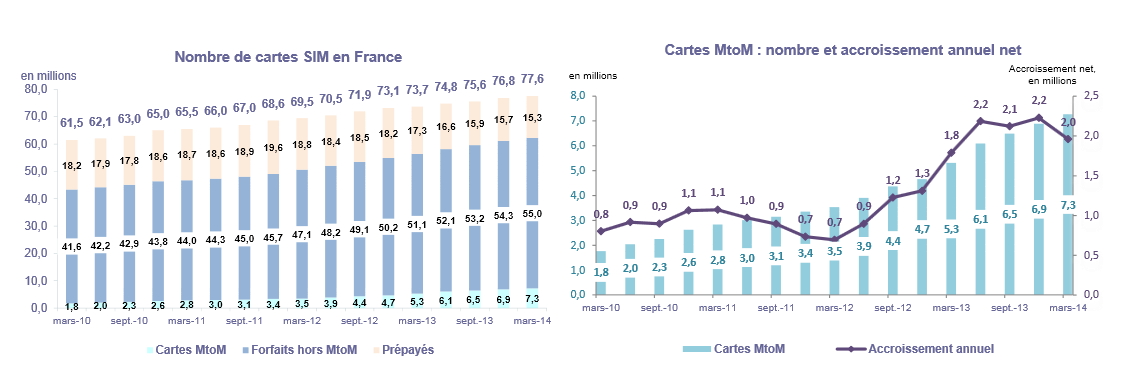
La croissance du marché mobile français reste imperturbable. Elle a cru annuellement de 5,3% au cours du premier trimestre 2014 pour atteindre les 77,6 millions de cartes SIM, selonl’Observatoire des marchés de l’Arcep (Autorité de régulation des communications électroniques et des postes). Soit un taux de pénétration de 117,9% sensiblement inférieur aux 125% constatés en Europe selon l’UIT.
Quelque 745 000 nouvelles puces ont été activées en début d’année par rapport au 4e trimestre 2013. Et 3,9 millions en un an. Le marché est porté par les forfaits, en croissance de 700 000 sur le trimestre pour venir frôler les 55 millions d’unités. Une hausse de 7,7% sur un an qui se fait essentiellement sur le parc du pré-payé. A 15,3 millions d’utilisateurs, il recule de 11,5% annuellement.

Le M2M ralentit

Un recul largement compensé par la montée des besoins du M2M (Machine to Machine) qui alimente désormais 7,3 millions d’appareils connectés frôlant ainsi les 37% de croissance annuelle. Néanmoins, la croissance du marché du M2M connaît son troisième exercice en baisse : 385 000 cartes SIM ont été distribuées sur le premier trimestre 2014 contre 397 000 fin 2013 et plus de 400 000 au cours de l’été dernier. Une tendance guère rassurante pour un marché pourtant naissant et appelé à s’amplifier avec l’Internet des objets.
L’offre low cost poursuit sa dynamique. L’Observatoire note ainsi la progression, là aussi continue, de 9 points des forfaits mobiles sans engagement (low cost) et libres d’engagement. Ils constituent désormais 45,5% de l’ensemble des forfaits. Enfin, avec 8,5 millions d’abonnés, lesMVNO (opérateur mobile de réseau virtuel) occupent 11,3% des 74,8 millions de cartes SIM en service en métropole. En toute petite hausse annuelle de 0,4 point à l’heure où un mouvement de concentration pourrait également s’amorcer sur ce secteur avec la potentielle vente de Virgin Mobile.
Arcep mobile q1 2014
crédit photo © Ekaterina Pokrovsky – shutterstock

A Smart Watch Controlled by Twists, Tilts, and Clicks

A lire sur: http://www.technologyreview.com/news/527211/a-smart-watch-controlled-by-twists-tilts-and-clicks/

A movable smart-watch screen makes it easier to read a map or play a game.

By Rachel Metz on May 14, 2014


Move it
: Researchers at Carnegie Mellon University developed a prototype smart watch whose face can be clicked, tilted, and twisted by moving the bezel.

The first time I tried out a smart watch with a touch screen, I quickly went from feeling excited to feeling clumsy. Tapping or swiping the small display on my wrist often failed to yield the response I expected. It might have been the quality of the screen, but it may have also been simply that the screen was too small and my fingers too big.
Touch screens have largely obliterated clickable keyboards and scrolling buttons or wheels on smartphones in favor of tapping, swiping, pinching, and flicking. Yet when it comes to smaller gadgets like smart watches, they’re not always the best way to access information, and other methods like voice recognition still aren’t that reliable either.
project at Carnegie Mellon University suggests a better way to control these new gadgets: allowing users to physically tilt, click, and twist the watch’s bezel, the area around the screen. This could make it much easier to do things like set up appointments, play music, or navigate a map on the tiny display.
“It’s not that these watches aren’t fast enough or even have enough battery life—it’s that we can’t get the input and output good enough,” says Chris Harrison, an assistant professor of human-computer interaction at Carnegie Mellon University, who worked on the project with several colleagues.
The group built a prototype device and presented a paper detailing it at the recentACM CHI Conference on Human Factors in Computing Systems in Toronto.
Harrison says the researchers tried to adhere to certain rules when making the prototype: it shouldn’t feel cramped to use, and users shouldn’t have to lift their fingers from the screen while using it. A 1.5-inch display sits in front of an ARM processor, and two Hall-effect displacement sensors measure movements of the screen along two different axes. This allows for clicks, tilts, pans, and twists. The watch is connected to a laptop running software that processes the user’s interactions and runs an app that is shown on the watch face.
A video posted by the group (see below) shows a wearer interacting with a number of demo apps on the watch: clicking and twisting to set an alarm; tilting to pan across a map and twisting to zoom in; twisting and clicking to control the video game Doom, which researchers modified to run on the device.
The prototype looks bulky, and even if the technology were shrunk down, adding it to a smart watch would be likely to increase the gadget’s overall size and put more strain on its battery. Mechanical parts can also make for headaches in mobile devices, as they can gather dust, get wet, and break.
To address some of these issues, Harrison says, a commercial smart watch that has this kind of functionality could be made with pressure sensors rather than mechanical ones. He says you don’t feel the movements as much as you do with mechanical sensors, though.


Ultimately, some of these issues may not matter much; Harrison is also exploring ways we can control smart watches without even touching them. A newer project, which he won’t say much about, investigates moving interactions onto the skin next to the gadget. “We’re really trying to think about ways to expand the interaction,” he says.

Windows Phone: The mobile world's third wheel

A lire sur: http://www.zdnet.com/windows-phone-the-mobile-worlds-third-wheel-7000029503/#ftag=RSS2452425

Summary: Bottom line, in almost four years Microsoft has accomplished little more with Windows Phone than becoming the mobile world's third wheel. The best way to change this is for Microsoft to embrace the competition -- Android.

By  for Hardware 2.0 |
While no one can doubt that Windows is the platform that controls the PC landscape, when it comes to the mobile arena, Microsoft is a small fish in a very large ocean dominated by Android and, to a lesser extent, iOS.
Windows Phone was announced more than four years ago, and made its initial debut in the US in November 2010. During that time the platform has grown from zero to grab a 3 percent market share. This figure is backup up by reports from Canalys and ABI Research.
Bottom line, in almost four years Microsoft has accomplished little more than becoming the mobile world's third wheel.
Android on the other hand is booming, dwarfing the competition with an 81 percent share of the smartphone market (excluding basic mobile handsets), a number supported by both the Canalys and ABI Research reports. Apple's iOS is holing its own with a sub 20 percent (which doesn't seem much until you realize that this figure is for a single brand – the iPhone).
Bottom line, in almost four years Microsoft has accomplished little more than becoming the mobile world's third wheel.
Now don't get me wrong, I think the Windows Phone operating system is an excellent platform, and it brings a number of innovations to the table. It's also currently the only viable third ecosystem since the disintegration of BlackBerry. If you want something other than Android or iOS, then Windows Phone is pretty much all there is.
It's pointless debating why Windows Phone hasn't been the hit Microsoft expected it to be. There's been enough finger-pointing at the confusion over the branding, the lack of developer support, Microsoft's lateness to the market with a platform, and the overall lack of visibility of Windows Phone-powered handsets. What matters is what the future holds for the platform.
Barring a miracle, I can't see Windows Phone posing any serious threat to either the iOS or the Android platforms. Both platforms are too well established, have too much market traction, and are too widely supported by developers to have much to fear. The best I think that Microsoft can hope for is to snag a few percentage points here and there.
But what about all those folks wanting to upgrade from basic handsets to smartphones? Surely there's an opportunity there? Well, there may be, but the data as it stands isn't promising.
"Interestingly, basic mobile phones lost 5% market share and Android picked up almost all of these users, suggesting Android is set to gain almost all of the billions of mobile subscribers still upgrading to smartphones. Certainly, Android looks set to completely dominate the high growth developing markets and increase its market share still further," said Nick Spencer, senior practice director, mobile devices at ABI Research.
In other words, don't bet on it.
So, what's left for Microsoft?
If you can't beat them, join them. And by them, I mean Android.
Microsoft doesn’t have to abandon Windows Phone to embrace Android. It can still keep the project alive, and perhaps even work to further integrate Windows Phone with the Windows platform. Over time this might lead to something.
Or it might not.
In the meantime, Microsoft can load Android on a select number of Nokia handsets, handsets that have been customized to point to Microsoft services rather than those offered by Google, and as users partake of those services, so the dollars will slow to Microsoft.
And at the bottom of all of it, that's what Microsoft cares the most about. While market share and dominance offers bragging rights – and the chance to better steer the ecosystem – it's money that really drives a corporation. And it doesn't matter if that money is coming from Android devices, because money is money and it all spends the same.
But even this route is not without its difficulties. For example, Microsoft's Android handsets won't have access to the vastness of the Google Play store.
If Microsoft can put ego aside, Android gives it the opportunity to gain a foothold in the mobile space. At the very least, Android gives it an opportunity to pull in some mobile dollars.