Les nouveaux usages d'aujourd'hui seront les business de demain.
Revue de presse sur les tendances et évolutions technologiques utiles.
http://theitwatcher.fr/.
A quelques semaines de son rendez-vous partenaires « Worldwide Partner Conference 2014″, Microsoft dévoile les résultats de sa nouvelle étude menée par IDC sur les opportunités du Cloud.
L’étude réalisée cette année vient compléter celle menée en 2013 sur les performances des partenaires autour du Cloud. L’étude 2014 confirme ainsi les tendances révélées en 2013.
Les résultats d’IDC montrent notamment les bénéfices du passage au Cloud. D’après l’étude, « les partenaires engagés dans le Cloud (plus de 50% de leurs revenus) connaissent une croissance de leur marge brute en moyenne 1,5 fois supérieure à celle des autres partenaires. Ils affichent en moyenne un ratio de nouveaux clients supérieur de 1,3 fois. »
Successful Cloud Partners 2.0
Dans son étude IDC a sondé plus de 700 partenaires à travers le monde, dont 36% en Europe de l’Ouest. Le résultat illustre les opportunités du Cloud pour les partenaires, et notamment en termes de rentabilité et de développement commercial.
En conclusion, Microsoft et IDC préconisent de vite se mettre au Cloud si ce n’est pas déjà fait. « Je pense que la première étape importante est de comprendre que les clients se tournent vers le Cloud. Et c’est aux partenaires de décider si oui ou non, ils veulent les aider à le faire. Parce que ce n’est pas une question de ‘si’, ni de ‘quand’, ou de ‘qui’ va aider à le faire. Ceux qui proposent un business model Cloud seront les premiers», explique Matt McGillen, de Microsoft.
L’étude revient également sur les bonnes pratiques des partenaires à la pointe en matière de Cloud pour permettre aux autres d’effectuer leur transition vers ces nouveaux business models. « Arrêtez ce que vous faites et construisez votre stratégie Cloud », conseille l’étude.
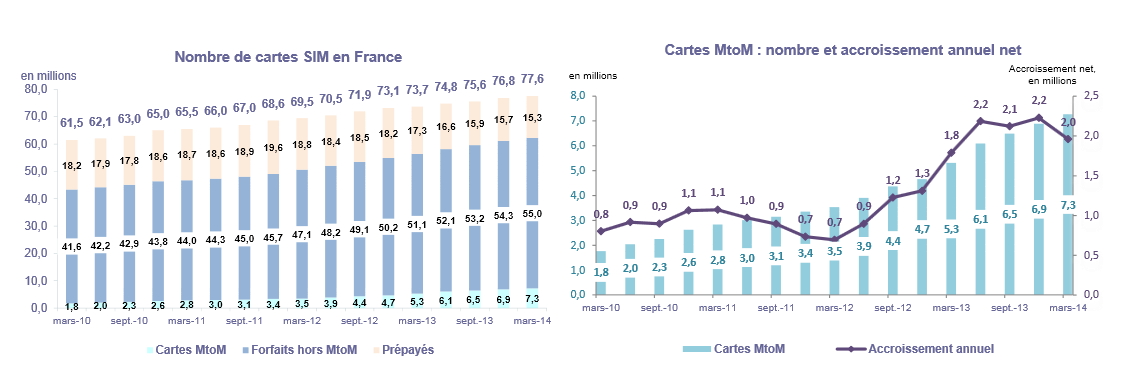
La croissance du marché mobile français reste imperturbable. Elle a cru annuellement de 5,3% au cours du premier trimestre 2014 pour atteindre les 77,6 millions de cartes SIM, selonl’Observatoire des marchés de l’Arcep (Autorité de régulation des communications électroniques et des postes). Soit un taux de pénétration de 117,9% sensiblement inférieur aux 125% constatés en Europe selon l’UIT.
Quelque 745 000 nouvelles puces ont été activées en début d’année par rapport au 4e trimestre 2013. Et 3,9 millions en un an. Le marché est porté par les forfaits, en croissance de 700 000 sur le trimestre pour venir frôler les 55 millions d’unités. Une hausse de 7,7% sur un an qui se fait essentiellement sur le parc du pré-payé. A 15,3 millions d’utilisateurs, il recule de 11,5% annuellement.
Le M2M ralentit
Un recul largement compensé par la montée des besoins du M2M (Machine to Machine) qui alimente désormais 7,3 millions d’appareils connectés frôlant ainsi les 37% de croissance annuelle. Néanmoins, la croissance du marché du M2M connaît son troisième exercice en baisse : 385 000 cartes SIM ont été distribuées sur le premier trimestre 2014 contre 397 000 fin 2013 et plus de 400 000 au cours de l’été dernier. Une tendance guère rassurante pour un marché pourtant naissant et appelé à s’amplifier avec l’Internet des objets.
L’offre low cost poursuit sa dynamique. L’Observatoire note ainsi la progression, là aussi continue, de 9 points des forfaits mobiles sans engagement (low cost) et libres d’engagement. Ils constituent désormais 45,5% de l’ensemble des forfaits. Enfin, avec 8,5 millions d’abonnés, lesMVNO (opérateur mobile de réseau virtuel) occupent 11,3% des 74,8 millions de cartes SIM en service en métropole. En toute petite hausse annuelle de 0,4 point à l’heure où un mouvement de concentration pourrait également s’amorcer sur ce secteur avec la potentielle vente de Virgin Mobile.
Move it
: Researchers at Carnegie Mellon University developed a prototype smart watch whose face can be clicked, tilted, and twisted by moving the bezel.
The first time I tried out a smart watch with a touch screen, I quickly went from feeling excited to feeling clumsy. Tapping or swiping the small display on my wrist often failed to yield the response I expected. It might have been the quality of the screen, but it may have also been simply that the screen was too small and my fingers too big.
Touch screens have largely obliterated clickable keyboards and scrolling buttons or wheels on smartphones in favor of tapping, swiping, pinching, and flicking. Yet when it comes to smaller gadgets like smart watches, they’re not always the best way to access information, and other methods like voice recognition still aren’t that reliable either.
A project at Carnegie Mellon University suggests a better way to control these new gadgets: allowing users to physically tilt, click, and twist the watch’s bezel, the area around the screen. This could make it much easier to do things like set up appointments, play music, or navigate a map on the tiny display.
“It’s not that these watches aren’t fast enough or even have enough battery life—it’s that we can’t get the input and output good enough,” says Chris Harrison, an assistant professor of human-computer interaction at Carnegie Mellon University, who worked on the project with several colleagues.
Harrison says the researchers tried to adhere to certain rules when making the prototype: it shouldn’t feel cramped to use, and users shouldn’t have to lift their fingers from the screen while using it. A 1.5-inch display sits in front of an ARM processor, and two Hall-effect displacement sensors measure movements of the screen along two different axes. This allows for clicks, tilts, pans, and twists. The watch is connected to a laptop running software that processes the user’s interactions and runs an app that is shown on the watch face.
A video posted by the group (see below) shows a wearer interacting with a number of demo apps on the watch: clicking and twisting to set an alarm; tilting to pan across a map and twisting to zoom in; twisting and clicking to control the video game Doom, which researchers modified to run on the device.
The prototype looks bulky, and even if the technology were shrunk down, adding it to a smart watch would be likely to increase the gadget’s overall size and put more strain on its battery. Mechanical parts can also make for headaches in mobile devices, as they can gather dust, get wet, and break.
To address some of these issues, Harrison says, a commercial smart watch that has this kind of functionality could be made with pressure sensors rather than mechanical ones. He says you don’t feel the movements as much as you do with mechanical sensors, though.
Ultimately, some of these issues may not matter much; Harrison is also exploring ways we can control smart watches without even touching them. A newer project, which he won’t say much about, investigates moving interactions onto the skin next to the gadget. “We’re really trying to think about ways to expand the interaction,” he says.
A lire sur: http://www.zdnet.com/windows-phone-the-mobile-worlds-third-wheel-7000029503/#ftag=RSS2452425
Summary: Bottom line, in almost four years Microsoft has accomplished little more with Windows Phone than becoming the mobile world's third wheel. The best way to change this is for Microsoft to embrace the competition -- Android. By Adrian Kingsley-Hughes for Hardware 2.0 |
While no one can doubt that Windows is the platform that controls the PC landscape, when it comes to the mobile arena, Microsoft is a small fish in a very large ocean dominated by Android and, to a lesser extent, iOS.
Windows Phone was announced more than four years ago, and made its initial debut in the US in November 2010. During that time the platform has grown from zero to grab a 3 percent market share. This figure is backup up by reports from Canalys and ABI Research.
Bottom line, in almost four years Microsoft has accomplished little more than becoming the mobile world's third wheel.
Android on the other hand is booming, dwarfing the competition with an 81 percent share of the smartphone market (excluding basic mobile handsets), a number supported by both the Canalys and ABI Research reports. Apple's iOS is holing its own with a sub 20 percent (which doesn't seem much until you realize that this figure is for a single brand – the iPhone).
Bottom line, in almost four years Microsoft has accomplished little more than becoming the mobile world's third wheel.
Now don't get me wrong, I think the Windows Phone operating system is an excellent platform, and it brings a number of innovations to the table. It's also currently the only viable third ecosystem since the disintegration of BlackBerry. If you want something other than Android or iOS, then Windows Phone is pretty much all there is.
It's pointless debating why Windows Phone hasn't been the hit Microsoft expected it to be. There's been enough finger-pointing at the confusion over the branding, the lack of developer support, Microsoft's lateness to the market with a platform, and the overall lack of visibility of Windows Phone-powered handsets. What matters is what the future holds for the platform.
Barring a miracle, I can't see Windows Phone posing any serious threat to either the iOS or the Android platforms. Both platforms are too well established, have too much market traction, and are too widely supported by developers to have much to fear. The best I think that Microsoft can hope for is to snag a few percentage points here and there.
But what about all those folks wanting to upgrade from basic handsets to smartphones? Surely there's an opportunity there? Well, there may be, but the data as it stands isn't promising.
"Interestingly, basic mobile phones lost 5% market share and Android picked up almost all of these users, suggesting Android is set to gain almost all of the billions of mobile subscribers still upgrading to smartphones. Certainly, Android looks set to completely dominate the high growth developing markets and increase its market share still further," said Nick Spencer, senior practice director, mobile devices at ABI Research.
In other words, don't bet on it.
So, what's left for Microsoft?
If you can't beat them, join them. And by them, I mean Android.
Microsoft doesn’t have to abandon Windows Phone to embrace Android. It can still keep the project alive, and perhaps even work to further integrate Windows Phone with the Windows platform. Over time this might lead to something.
Or it might not.
In the meantime, Microsoft can load Android on a select number of Nokia handsets, handsets that have been customized to point to Microsoft services rather than those offered by Google, and as users partake of those services, so the dollars will slow to Microsoft.
And at the bottom of all of it, that's what Microsoft cares the most about. While market share and dominance offers bragging rights – and the chance to better steer the ecosystem – it's money that really drives a corporation. And it doesn't matter if that money is coming from Android devices, because money is money and it all spends the same.
But even this route is not without its difficulties. For example, Microsoft's Android handsets won't have access to the vastness of the Google Play store.
If Microsoft can put ego aside, Android gives it the opportunity to gain a foothold in the mobile space. At the very least, Android gives it an opportunity to pull in some mobile dollars.
ReadWriteBody is an ongoing series where ReadWrite covers networked fitness and the quantified self.
It seems fashionable for audiophiles to beat up on Beats, the music-accessories business by Dr. Dre that Apple is reportedly interested in buying. But debating sound quality seems beside the point. I think Apple is placing a bet on a whole new category of electronics. Call it earable computers.
Earable computers, or earables, will look like existing audio accessories—earbuds, headphones, and the like. The inexorable trend towards miniaturization and wireless connectivity will mean that these devices will soon untether themselves from smartphones and connect us to news, entertainment, and people on their own.
The Ear Up There
Earables are the future of wearables.
other wearable devicess, earables will be attached to the body. I’d argue that they have more market potential than, say, smartwatches, which aren’t for everyone. They definitely have more appeal than so-called “face computers” like Google Glass, which has proven to be awkward and embarrassing and may ultimately prove socially unacceptable to use outside of limited industrial settings.
But headphones are everywhere. Almost everyone uses some kind of ear bud with other devices to play music and take phone calls. The question is what else these devices can do.
A recent rumor about Apple adding fitness features to its EarPods, though debunked, pointed to something quite real: Apple's EarPods already have a chip in the built-in remote. Devices attached to our ears could do a lot that we rely on smartphones for, like carry alerts and notifications. Earables could sense the condition of our body, picking up biological signals like heart rate through our skin.
I’ve seen several fitness-related devices with some kind of ear interface. Pear Sports, for example, makes its own custom earphones with a controller that will give real-time heart-rate information, while its app feeds training cues through the speakers.
Siri Inside Beats?
The most fascinating product inside the Beats portfolio are its Studio Wireless Headphones. With Bluetooth connectivity and a digital processor for noise cancellation, this headset already is a connected computing device—albeit one with very limited functions.
Add Apple’s M7 coprocessor, though, and it could track your steps. Add a full-fledged processor and a voice-controlled Siri, and you could ask questions and get answers. Today, Bluetooth devices must be tethered to a smartphone, but the wireless technology is evolving quickly, and soon smart gadgets will be able to talk to each other. That means my Bluetooth heart-rate monitor could whisper the pounding of my own heart into my ears as I work out. My beats on my Beats, if you will.
The potential is unlimited—which is why Apple’s interest in Beats isn’t limited to its nascent streaming music service, I believe. Apple has long understood the power of audio in all forms. By upending industry groupthink and focusing its effort on earables, Apple could create a whole new category of consumer electronics—again.
A lire sur: http://blogs.lecho.be/tzine/2014/05/une-imprimante-3d-construite-%C3%A0-partir-de-d%C3%A9chets-informatiques.html
Posté le 15 mai 2014 par Vincent Papaleo
Non, la débrouillardise légendaire des Africains ne concerne pas uniquement la mécanique : les technologies de pointe peuvent également être bricolées à partir de matériel de récupération. Un fablab au Togo démontre qu’il est par exemple possible de créer une imprimante 3D avec du matériel provenant d’une décharge.
Nous avons tous en tête ces images honteuses de décharges informatiques qui polluent le sol africain. Si vous vous rendez dans l’une de ces décharges, au Togo, vous tomberez certainement sur Afate, un petit bricoleur de génie qui trouve là tout ce dont il a besoin pour bricoler sa propre imprimante 3D. Afate travaille sur son projet au sein d’un fablab, un atelier de bricolage numérique participatif. C’est là qu’il plie, soude et branche les différents éléments de sa future imprimante 3D uniquement en utilisant des déchets informatiques !
Le but ultime d’Afate est d’imprimer de petits objets en plastique difficilement accessibles sur le marché africain. De petits objets imprimés qui, à leur tour, viendront compléter l’une ou l’autre machine récupérée dans la décharge. Une leçon de débrouillardise et d’ingéniosité qui devrait apporter de l’eau au moulin de l’éco-conception.
A lire sur: http://blogs.lecho.be/tzine/2014/05/des-routeurs-am%C3%A9ricains-bidouill%C3%A9s-par-la-nsa.html
Posté le 15 mai 2014 par Vincent Papaleo
Des documents dérobés par Edward Snowden à la NSA apportent un nouvel éclairage aux techniques d’espionnage utilisées par l’agence. Selon ces documents, la NSA aurait intercepté des routeurs américains commandés par des sociétés étrangères afin d’y placer des portes dérobées. De cette manière, la NSA s’est ménagé un accès direct aux données transitant sur les réseaux internes des entreprises ciblées.
La nouvelle n’aurait en fait rien d’étonnant et n’ajouterait qu’une page de plus au dossier à charge de l’agence de renseignements américaine si cette information ne soulevait pas également un autre coin du voile : les raisons pour lesquelles le gouvernement américain s’était opposé si vigoureusement à la commercialisation d’équipements réseaux chinois sur le sol américain en 2012. En effet, cette année-là, Huawei et ZTE souffrirent des recommandations du gouvernement américain aux sociétés nationales de se tourner vers d’autres équipements réseaux que ceux proposés par les deux sociétés chinoises. À l’époque, ce sont les risques lié à l’espionnage chinois qui avaient été avancés comme raison à cette défiance. En réalité, et à la lecture des documents livrés par le lanceur d’alerte Edward Snowden, il semble bien que la mise en place de routeurs chinois aurait surtout empêché celle de routeurs américains dotés de portes dérobées !
L’équipement technologique étant de plus en plus souvent au cœur de l’espionnage entre États, il n’est pas étonnant que ces véritables nœuds de l’information que sont les routeurs soient une cible privilégiée pour les agences de renseignements. Seulement voilà, dans ce cas précis, les routeurs bidouillés par la NSA étaient destinés à des sociétés étrangères, non pas à des gouvernements. Les collusions entre plusieurs sociétés américaines et la NSA n’étant plus qu’un secret de polichinelle, il ne serait pas excessif d’y voir un bel exemple d’espionnage industriel. Et pendant ce temps-là, le gouvernement belge en est encore à planifier la cybersécurité des réseaux des services publics…