Les nouveaux usages d'aujourd'hui seront les business de demain.
Revue de presse sur les tendances et évolutions technologiques utiles.
http://theitwatcher.fr/.
A lire sur: http://spectrum.ieee.org/biomedical/devices/electronic-skin-lights-up-when-touched
Imagine an interactive dashboard or wallpaper inspired by the body’s largest organ
By Mia Feldman
Posted
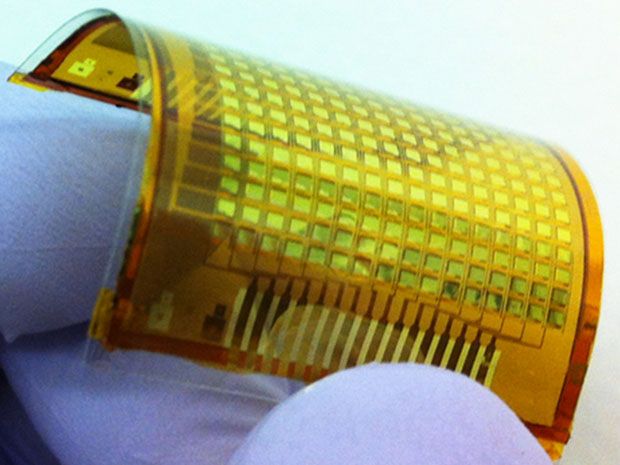
Photo: Ali Javey and Chuan WangSupple Skin: Built on plastic the new electronic skin contains arrays of pressure sensors, thin-film transistors, and organic LEDs.
A team of researchers at the University of California, Berkeley, has developed the first user-interactive “electronic skin” that responds to pressure by instantly emitting light.
“The goal is to use human skin as a model and develop new types of
electronics that would enable us to interface with our environment in
new ways,” explains Ali Javey, an electrical engineering and computer science professor at Berkeley and leader of the e-skin research team.
The electronic skin is made up of a network of sensors placed on thin
plastic substrates that can spatially and temporarily map pressure.
Javey describes the network as an array of 16 by 16 pixels, each one
equipped with a carbon-nanotube thin-film transistor (TFT), a pressure
sensor, and an organic light-emitting diode (OLED)
on top. When the sensor detects touch, the TFT powers up the OLED,
which then emits red, green, or blue light. The harder the pressure, the
brighter the light will be. The end product is a thin, flexible
material that can be placed on top of all sorts of surfaces.
Takao Someya, creator of a different type of electronic skin
and an associate professor at the University of Tokyo’s Quantum Phase
Electronics Center, was particularly impressed with the team’s use of
carbon nanotubes. “One of their great achievements is to demonstrate
feasibility of carbon nanotube field-effect transistors for large-area,
flexible electronic applications,” he says.
Javey, who has been working on developing the e-skin for the past five
years, has high hopes for his new material. He’d like to create
user-interactive wallpaper or a dashboard that responds to cues such as
the driver’s eye or body movements. When asked to describe how the
interactive wallpaper would work, Javey referred to the scene in Minority Report
in which Tom Cruise controls a computer by moving his hands. “That’s
the direction we’re heading to—a new type of interfacing,” he says.
“Getting rid of the keyboard, getting rid of display, and become in sync
with our surroundings so that you don’t have these physical components
sitting around. It’s part of the table; it’s part of the wall.”
In Javey’s proposed system, light sensors would read hand and body
motions, and pressure sensors would respond to different degrees of
touch. But there’s a good deal of work that must be done before we’ll be
seeing interactive wallpaper, he says. “We know how to make complex
systems on tiny silicon chips, but on plastic it’s a whole different
story,” Javey says. “It’s still not a very complex system we have shown,
but it’s still one of the most complex systems we have to date on
plastic.” He adds that his team is interested in integrating light
sensors as well as data-processing and wireless-communication
capabilities onto the substrates.
“This is an inspiring development in the plastic device technology,
which is likely to make many everyday experiences more stimulating,”
says Nicholas Kotov, a professor at the University of Michigan who is
working on flexible, stretchable electronics. John Rogers, a
materials science professor at the University of Illinois at
Urbana-Champaign, says “the work illustrates the extent to which
research in nanomaterials, once confined strictly to fundamental study
on individual test vehicles, is now successfully moving toward
sophisticated, macroscale demonstrator devices, with unique function.
The results provide more evidence that the field is headed in the right
direction.”
I would like to thank you for the efforts you have put in writing this site. I am hoping the same high-grade website post from you in the upcoming as well. In fact your creative writing skills has inspired me to get my own site now. Really the blogging is spreading its wings quickly. Your write up is a good example of it.

I would like to thank you for the efforts you have put in writing this site. I am hoping the same high-grade website post from you in the upcoming as well. In fact your creative writing skills has inspired me to get my own site now. Really the blogging is spreading its wings quickly. Your write up is a good example of it.
RépondreSupprimerdigital brief Melbourne